
What does pool pump repair in Temecula and Murrieta involve?
Pump repair investigates noise, leaks, lost prime or reduced circulation together with the pump model and system conditions. Similar symptoms can have different causes. Share when the issue occurs, and avoid opening energized equipment; an assessment establishes whether repair or replacement is the appropriate next step.
- How much does pool pump repair in Temecula and Murrieta cost?
- Pool Pump Repair is quoted for the actual equipment, water condition and work required; no fixed specialty rate is advertised here. The $159 monthly starting price applies to recurring pool care, not automatically to this service. Request an assessment and a clear scope and price before deciding.
- Can Sharkey's service my property in Temecula and Murrieta?
- Sharkey's lists Temecula, Murrieta, Wildomar, Winchester, Menifee, Canyon Lake, French Valley as service areas. Share your full address and access arrangements to confirm availability and a route day. A city or subdivision guide is not proof of an existing customer, HOA contract or guaranteed service at every address.
- What should I send for a pool pump repair quote?
- Start with your pool type, requested service and city. Include your address, current water condition, equipment model numbers and relevant photos when available. Sharkey's confirms access, scheduling and the work for your property before you agree. Do not open unsafe equipment to obtain a photograph.
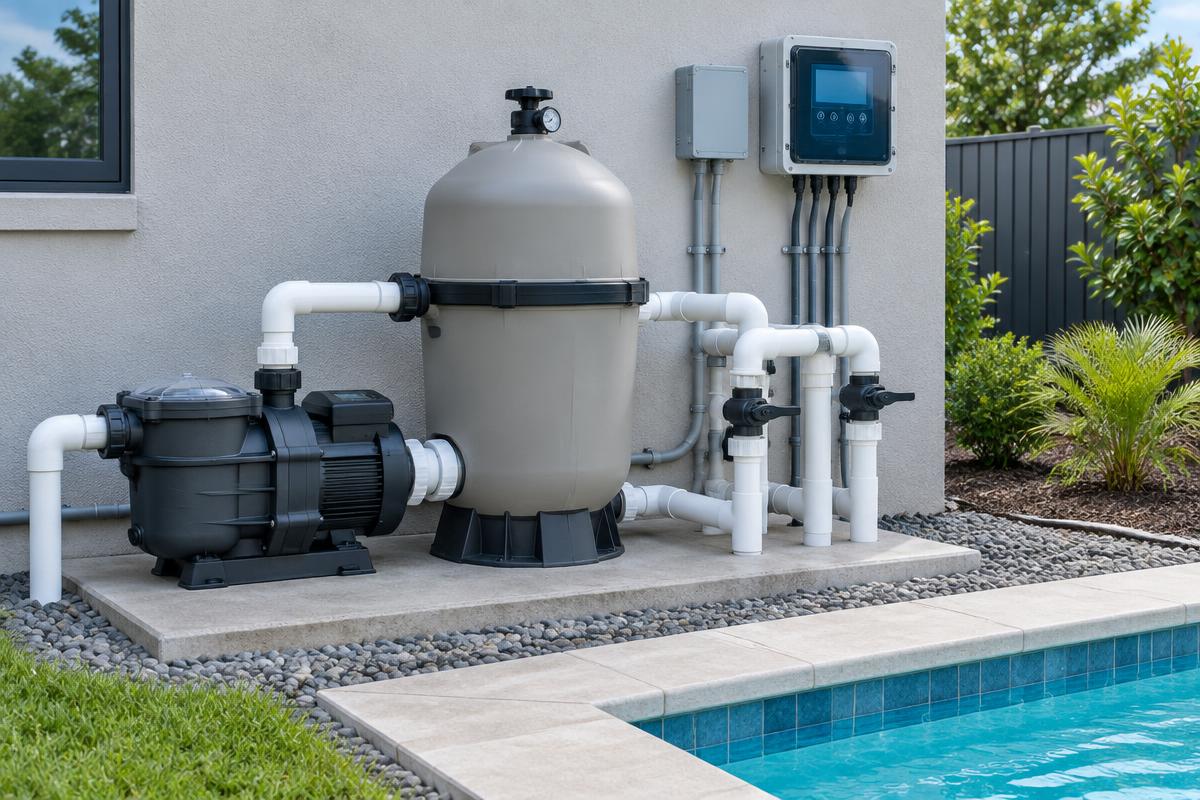
Your pool pump repair guide
A pool pump concern may appear as unusual noise, reduced circulation, visible moisture, an unexpected shutdown, or a control message. Those observations are useful, but none establishes a complete diagnosis by itself. Sharkey's Pool Cleaning serves pool owners in Temecula, Murrieta, Wildomar, Winchester, Menifee, Canyon Lake, and French Valley. Contact the business to discuss your pump symptoms and whether the requested work fits current availability. Preparing a clear account of operating changes, equipment history, and connected features helps keep the conversation focused on the actual concern rather than an assumed repair or premature replacement.
Record What the Pump Is Doing Differently
Compare the current behavior with the pump's usual operation. Describe whether it does not start, starts inconsistently, stops unexpectedly, or runs while water movement appears different. If you hear a new sound, explain whether it is steady, intermittent, or linked to a particular operating period. Avoid assigning a technical cause based on sound alone. The same general complaint can arise under different conditions. A simple timeline that notes when the behavior began and whether it has become more frequent is often more useful than a long list of possible failed components.
Visible information can add context without requiring hands-on investigation. From a safe position, note any display message, obvious wet area, or change in the water visible through an accessible pump lid. Share a photograph of the overall equipment arrangement and a readable equipment label if practical. Do not remove electrical covers, reach into moving equipment, or repeatedly attempt restarts to reproduce a problem. If there is a burning odor, smoke, exposed wiring, or water contacting electrical equipment, keep clear and obtain appropriate professional or emergency guidance instead of treating the situation as ordinary troubleshooting.
Consider Circulation Beyond the Pump Itself
The pump operates within a circulation system that includes the pool, plumbing, valves, filter, and sometimes heating or other accessories. A change elsewhere can affect what you observe at the pump. Reduced return flow does not automatically mean the motor has failed, and visible air does not identify a single source by itself. Explain whether the concern affects the entire pool, only a spa mode, or a particular feature. That distinction helps frame the conversation around operating conditions rather than assuming that the pump is necessarily the only component involved.
Recent events are especially useful when discussing circulation changes. Mention filter maintenance, equipment replacement, pool draining performed by others, plumbing work, or control adjustments that occurred before the symptom appeared. Do not change valve positions or dismantle components simply to test an idea before calling. Instead, report what is known and which details are uncertain. Ask whether the concern may require looking at connected equipment as well as the pump. This helps distinguish a pump-specific repair discussion from a broader circulation concern and reduces the chance of expecting one component change to solve unrelated conditions.
Your pool. A clear next step.
Get help with pump noise or lost flow
Share the pump model and when the symptom started.
No payment to request a quote. Work and pricing are agreed before you decide.
Distinguish Mechanical Symptoms from Control Questions
A pump that runs at unexpected times may raise a scheduling or control question rather than the same question as a pump that cannot operate. Describe whether it is managed locally, through a separate controller, or through a system that also operates other pool features. Share any recent changes in how those controls are used. Avoid assuming that a schedule display confirms the equipment actually followed that schedule. The useful information is the difference between what you expected, what the controls showed, and what you directly observed at the pool.
Mechanical observations deserve similarly careful wording. Water around the pump, a new vibration, or a noticeable change in sound may help narrow the discussion, but these are not instructions to open the housing or inspect internal parts. Ask which observations can be reviewed safely before an appointment and which require an appropriate professional. If the equipment has both a pump and separate control hardware, clarify which portion of the system a proposed repair addresses. A motor-related repair, a hydraulic concern, and a control issue can involve different decisions even when their outward symptoms overlap.
Connected pool services
Evaluate Repair Against the Existing Pump's Condition
Repair may be worth discussing when the concern appears limited, but the decision should include the pump's broader condition and operating history. Share whether the same symptom has returned after earlier work and whether other parts of the assembly have known issues. Ask what a proposed repair would restore and what it would leave unchanged. A repair intended to address leakage, for example, should not be assumed to resolve separate scheduling or circulation concerns. The conversation is strongest when each reported problem is matched to a clearly explained proposed action.
Replacement deserves its own comparison rather than being treated as another name for repair. Questions may include whether the existing pump suits the pool's circulation needs, whether connected controls are compatible with a replacement, and what changes would be necessary around the equipment area. Do not assume that a larger pump would automatically improve performance or that a newer pump guarantees a particular savings amount. Ask for recommendations to be tied to the actual system and usage. Any equipment or installation pricing should be discussed separately from ongoing residential pool cleaning service.
Ready to discuss pool pump repair? Request your property-specific quote.
Set Clear Expectations for a Pump Repair Discussion
Ask what information is needed to determine whether the requested work is within scope. Useful details may include the pump's visible model identification, the pool and spa arrangement, connected features, and a concise symptom history. Clarify whether an initial conversation is informational or whether a separate evaluation is needed before a specific recommendation can be made. If a repair option is proposed, ask what is included, what remains uncertain, and how additional findings would affect authorization. These questions support an informed decision without expecting a definitive diagnosis from a short phone description.
Discuss access and operating concerns before an appointment is considered settled. Explain any narrow passage, locked gate, pet arrangement, or equipment enclosure that could affect access. If the pool depends on the pump for other functions, mention those connections rather than assuming they are obvious. Ask how to handle the affected equipment while awaiting guidance, particularly if it is behaving unpredictably. Do not rely on repeated resets or improvised electrical work. Scheduling, route fit, and the availability of any required specialist involvement should all be confirmed directly for the particular request.
Send a Pump Inquiry That Supports the Next Step
Organize your message around a few concrete points: your city, the pump's identifying information if visible, what changed, when it changed, and whether the issue is constant or intermittent. Include any exact display wording rather than a paraphrase that might lose useful detail. Mention related symptoms such as reduced returns or a heater message, but separate those observations from your own theory about the cause. If you are deciding between repair and replacement, say so explicitly. That allows the discussion to address both options without assuming that you have already authorized either one.
Reach Sharkey's Pool Cleaning at 951-725-1603 or info@sharkeyspoolcleaning.com to ask about your pump concern. Service locations include Temecula, Murrieta, Wildomar, Winchester, Menifee, Canyon Lake, and French Valley, with route and appointment availability confirmed through direct contact. Request a clear explanation of the next step and any information you should gather safely beforehand. Keep the pump inquiry separate from requests for routine cleaning unless you want both discussed. A well-organized inquiry helps establish the right conversation while preserving the distinction between a reported symptom, an evaluation, and an approved repair.
What is included, and what needs a separate quote?
Monthly service starts at $159. This is a starting rate, not a promise that every listed task is included at that price. Your package and property-specific quote establish the work.
| Task | Service boundary |
|---|---|
| Testing, basic balancing, basket and equipment checks | Recurring care; scope confirmed in your package |
| Brush, skim and bottom cleaning | Package-dependent; not all included in Basic |
| Two salt-cell cleans per year | Included in Complete; otherwise discuss scope |
| Two D.E. / multi-cartridge filter cleans per year | Included in Complete; otherwise discuss scope |
| Repairs, installation, tile work and green recovery | Separately assessed and quoted |
Routine care or a specialty visit?
Your recurring care plan
- Water testing and basic chemical balancing
- Basket checks and equipment inspection
- Cleaning tasks in your agreed package
- Visit photo and pool report
Discuss a specialty visit
- Green-pool recovery and intensive cleanouts
- Equipment repairs and replacements
- Tile cleaning and sand replacement
- Filter or salt-cell work beyond package inclusions
Your chosen package determines inclusions. Complete includes two salt-cell cleans and two D.E. / multi-cartridge filter cleans per year. We confirm other work and pricing before you decide.
A clearer record of pool care
Sharkey's sends a photo and pool report after every clean. This illustrative checklist is not a real customer visit or a promise of specific measured readings.
- Visit photo
- Water testing and notes
- Completed cleaning tasks
- Equipment observations
Your equipment quote checklist
- Pool type and approximate volume
- Equipment brand and model labels
- Current pressure and clean-filter baseline
- Error codes or changes in operation
- A safe exterior equipment photo
- Last cleaning or repair date, if known
- Property address and access requirements
- Preferred service and scheduling questions
Do not open electrical or gas equipment. Do not include gate codes in public messages.
Water testing: start with your actual pool
Dissolved calcium and magnesium contribute to water hardness and scale. Evaporation leaves minerals behind, but a city or neighborhood name does not establish your tap-water hardness. Check your water provider’s current report and test the pool itself before choosing treatment.
Weather is context, not a chemical reading
Sunlight, rain and debris can change water conditions. Routine sanitizer and pH checks matter even when the water looks clear. Follow your equipment and product instructions rather than dosing from a weather forecast.
EMWD’s report applies to its supply, not automatically to every address in our service areas.
A connected care plan
Pool Automation
Explore pool automation alongside your pool pump repair request.
Pool Equipment Repair
Explore pool equipment repair alongside your pool pump repair request.
Pool Pump Installation
Explore pool pump installation alongside your pool pump repair request.